The Etc. Files is a letter about reading power in systems built to hide it — and building the tools to do something about it. Tools for solidarity, sci-fi and community building, budget and political commentary, and the honest behind-the-scenes of the work, from Terra Gillespie.
SHARE
From the Borg to San Junipero to the X-Files, science fiction has been grappling with AI, surveillance, and what makes us human. Here’s how it shows up in the ‘real world’ (assuming we aren’t all plugged into the Matrix).
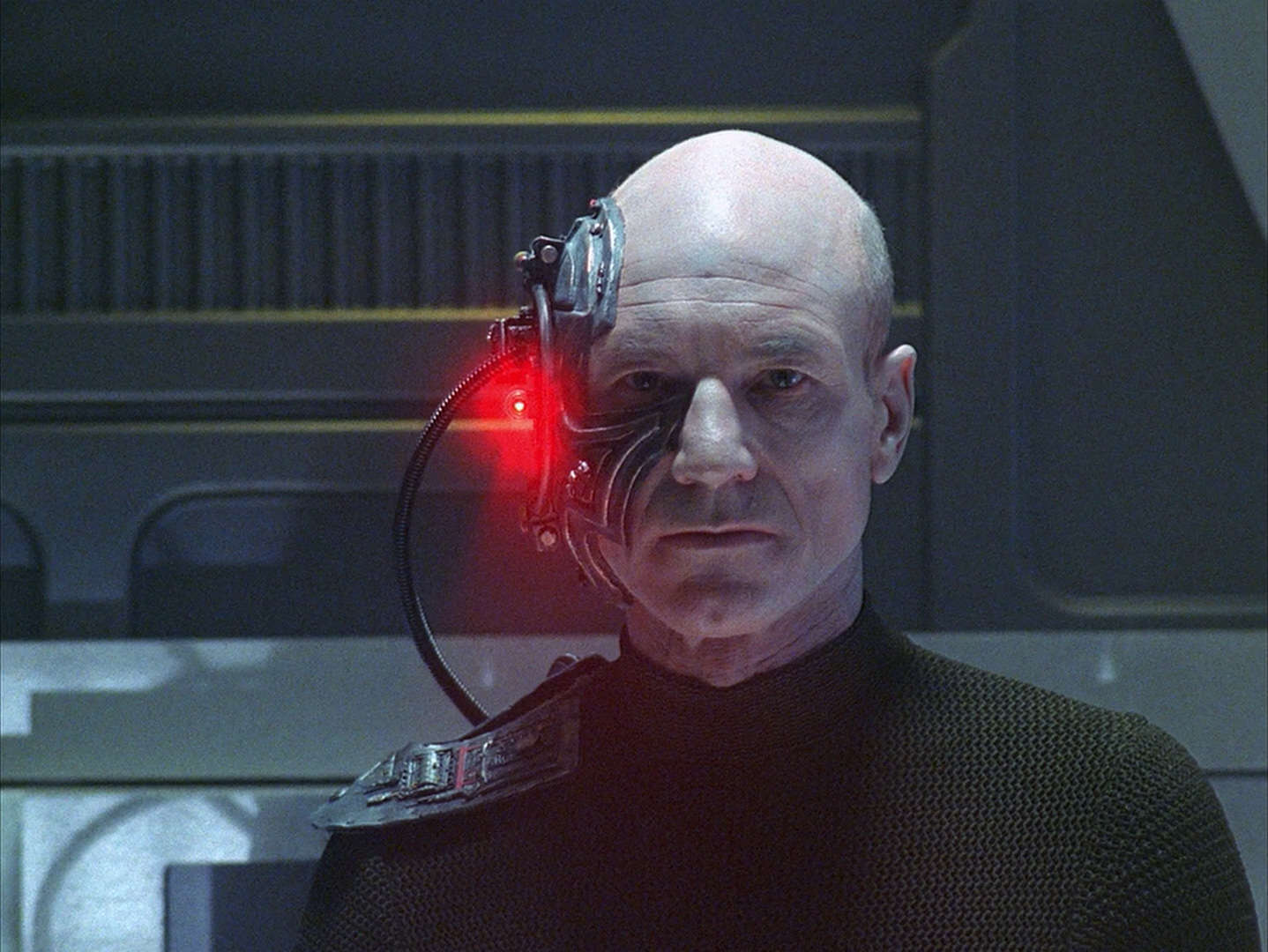
What surveillance capitalism has in common with the Borg.
"Resistance is futile." The Borg don't argue with you. They don't try to convince you. They absorb you, add your biological and technological distinctiveness to their collective, and move on. Your individuality is irrelevant. Your memories, your relationships, your particular way of seeing the world — these are not lost in any meaningful way, because the Borg don't recognize them as having been there.
I think about the Borg from Star Trek whenever I hear someone say "AI isn't going away" or "Adopt it or get left behind" while dismissing all privacy, environmental, and ethical concerns. The underlying message is: resistance is futile.
Is it just me who feels this way scrolling Instagram sometimes?
The business model of most major digital platforms is built on something remarkably similar to assimilation. Your behavioural patterns, your emotional responses, your social connections, your fears and desires and purchasing history — these are harvested, processed, and fed back to you as a mirror shaped to extract maximum engagement. You are not the customer. You are the product. Your distinctiveness has been added to their collective and is now being used to predict and shape your next move.
This is not a paranoid reading. It is the documented, publicly available business model of every major platform we use to run nonprofit digital campaigns. The question is not whether to work within these systems — most of us don't have a choice if we want to reach people — but whether we do so with clarity about what we're working with.
San Junipero and digital consciousness.
Black Mirror's San Junipero asks a different question: if consciousness can be uploaded to a digital simulation where it experiences joy indefinitely, is that liberation or imprisonment? The episode is achingly beautiful, and deliberately doesn't resolve the question. For a queer episode about two women falling in love at the end of their lives, the ambivalence about digital immortality feels honest — because for people whose bodies have been sites of pain and limitation, the offer of a different kind of embodiment is both seductive and suspicious.
Kelly + Yorkie 4eva
In nonprofit digital work, we talk a lot about digital transformation — moving communities, relationships, and impact into digital spaces. The questions San Junipero raises are not irrelevant to that conversation. What is lost in translation? Whose experience of the digital space is joyful, and whose is a repetition of the surveillance, harassment, and exclusion they experience in physical space?
Fringe and the problem with timelines.
Fringe gave us parallel universes, and specifically the horror of discovering that decisions made in other timelines ripple into yours — that the world you're in is, in part, the product of choices made by people who don't exist in your reality, in response to conditions you've never experienced. I think about Fringe whenever I try to untangle why a community is where it is digitally. The decisions that shaped a nonprofit's digital presence were made years ago, in different contexts, by people who may no longer be there, optimizing for goals that may have changed. The system you inherited is not the system you would have designed. But it is the system you're working in.
What makes a person unique in the age of AI?
Mickey 17 — the Robert Pattinson film based on Edward Ashton's novel — follows a disposable worker whose job is literally to die and be reprinted. He is the cheapest possible labour: death as a cost of doing business, personhood as something the corporation has already discounted. The film is dark and funny and, in 2026, uncomfortably topical given the ongoing conversation about AI-generated content replacing human creative workers.
Here's my take: what makes a person unique is not their outputs. It's the particular, specific, irreplaceable texture of their experience — the combination of who they've loved, what they've survived, what they find funny at 11pm, what makes them cry? And why is it a bird documentary? No model trained on human outputs can replicate that. Which means the answer to AI displacement isn't to make humans perform more like machines. It's to insist on the irreducibility of human interiority in the work we do.
What's your relationship to the technology you use in your work? Do you trust it? Are you suspicious of it? What would it mean to do digital strategy that was actually conscious of what we're working inside?
The Etc. Files is a letter about reading power in systems built to hide it — and building the tools to do something about it. Tools for solidarity, sci-fi and community building, budget and political commentary, and the honest behind-the-scenes of the work, from Terra Gillespie.